Sunday, 31 October 2010

Motherwell 0 v 1 Hamilton Academical

Saturday 30th October 2010
Scottish Premier League
Fir Park, Motherwell
Admission: £18.00
Programme: £3.00
Attendance: 4,865
Match Rating: 2


A second trip to southern Scotland in a fortnight posed a choice between visits to St Mirren, Dumbarton, Partick Thistle or Motherwell. In the end, I chose the latter, partially as I like to reward clubs that choose reasonable ticket prices, and £18.00 for a seat right on the midway line for a game in the Scottish Premier League certainly fell into that category, even though it meant a rather long journey from Prestwick airport. The train journey from Prestwick to Glasgow is always one I savour, as it passes along the scenic Ayrshire coast with views of the Isle of Arran in the distance and full views of the unenclosed football grounds of Troon and Irvine Victoria, both of the Ayrshire League, as the train passes above. After changing trains at Glasgow Central (and taking advantage of a quick tour of the city centre), Motherwell is about half hour train ride south-west.


Fir Park is located about a twenty minute walk from Motherwell station, via the town centre which, it has to be said, is instantly forgettable with little to entertain. I purchased my ticket for the game in advance on-line in order to choose my seat in the East Stand, which is an old-fashioned stand with seats bolted onto what used to be terracing. The views are very good, with only a couple of narrow pillars potentially obstructing views and this is where the most passionate of Motherwell fans congregate. Opposite is the Main Stand, again of the traditional variety but much narrower and taller than the East Stand. Behind one of the goals is a plain, unattractive but functional stand, and behind the other goal is the most impressive stand and of the two tiered variety, which looks somewhat out of the place as it towers over the much smaller other stands.Rather bizarrely, this stand, seemingly the best of the stadium, is allocated to the usually small following of away fans. Indeed, Fir Park is a mix of irregular stands, which is absolutely not a criticism, it adds to the the character of the ground. The programme was an impressive effort, designed well with plenty of information to digest about both teams.
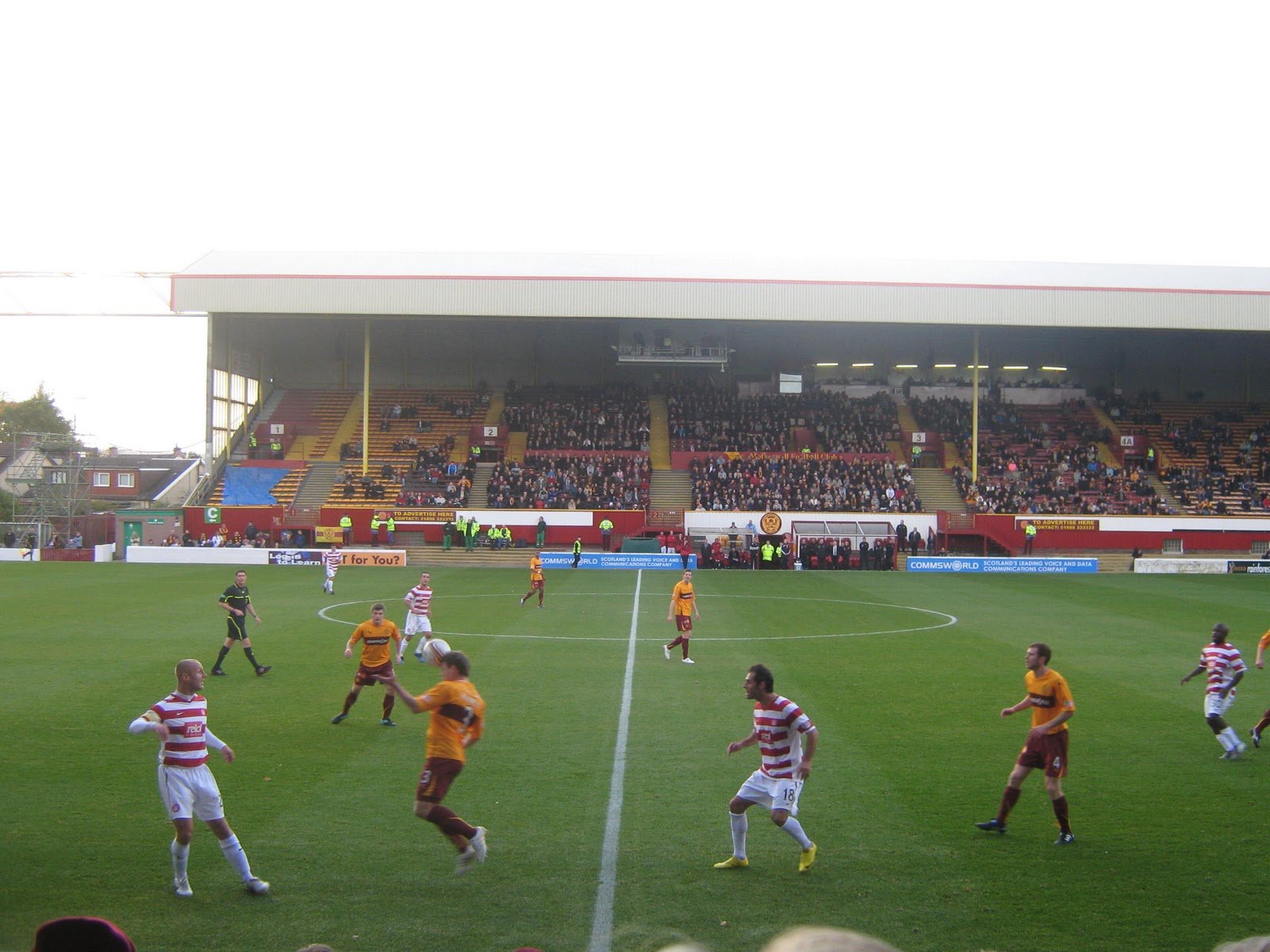


Today's match was a Lanarkshire derby between two clubs a couple of miles apart and separated by the M74, but who have enjoyed very different fortunes so far this season. Motherwell can currently boast the best of the rest tag after the Old Firm, flying high in third place and reaching the league cup semi-finals in midweek after their second victory against Dundee United at home within four days in midweek. With just one win and six points from their opening nine games, today's visitors, Hamilton Academical, are finding life much more difficult, as they usually do, unsurprisingly for a club of very limited resources, for whom being in the Premier League is an achievement. A difficult task for Hamilton became all the more apparent when it is considered that they haven't won at Motherwell in the league for 30 seasons, and not in the top-flight since 1938.


The game started off quite evenly, and quite typically for a local derby was, for the most part, a midfield battle. The gulf between the two clubs according to league positions was not apparent and it was not undeserved when Hamilton took the lead through a wonderful goal from Nigel Hasselbaink - nephew of Jimmy Floyd Hasselbaink - as he worked himself into space along the edge of the penalty area before unleashing a beautifully judged curling low shot in off the post. Motherwell increasingly did not look a side who were flying high in the table, showing little cohesion in their play with players guilty of poor touches and passes. Motherwell were given a chance to equalise a couple of minutes before half time when they were awarded a penalty when Nick Blackman was prevented from tucking the ball into an empty net by a barge from Martin Canning. Amazingly, the referee decided not to even book a player who denied a clear goalscoring opportunity and unfortunately, in a week where a lack of respect towards officials has been much in the Scottish news recently, this was just one example of a poor, bizarre performance by the referee. Much to Craig Brown's credit, he refused to criticise the referee's performance after the match, testament to the thoroughly decent man that he is. To compound the situation, Tomas Cerny easily saved a softly struck penalty from Tom Hateley low to his right. So, a shock result was on the cards at half time. Motherwell unsurprisingly dominated the second half but despite the odd half chance, never really looked like scoring as Hamilton set themselves up as a very strong unit who battled hard and in the end deserved to hold out for the win. This was not a game that was easy on the eye, but that suited Hamilton perfectly and full credit to them for grinding out a much needed victory.

Sunday, 24 October 2010

Carlisle United 3 v 4 Charlton Athletic

Saturday 23rd October 2010
Football League One
Brunton Park, Carlisle
Admission: £19.00 (Away Fans)
Programme: £1.00
Attendance: 5,624
Match Rating: 5


It has long been a desire of mine to visit Brunton Park, the most northerly Football League stadium in England, and just two weeks after visiting the southern and westernmost stadium at Plymouth Argyle, today I made it a reality. And as a Charlton fan...I couldn't have chosen a better day to make the long trip north!


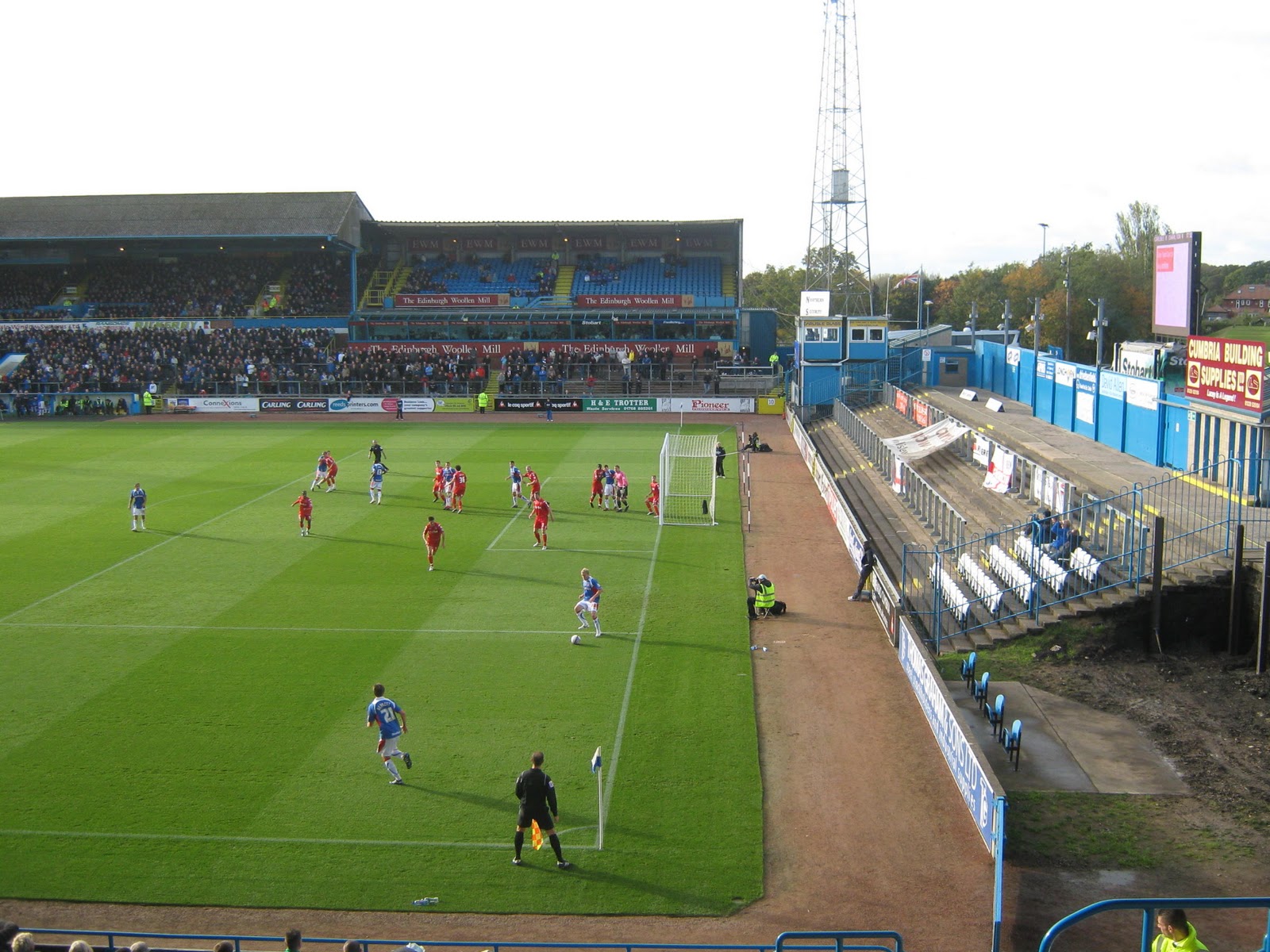
Once again taking advantage of cheap train tickets by booking almost three months in advance, I was whisked from London Euston to Carlisle in three and a quarter hours, and as I usually like to do, I arrived several hours ahead of kick-off, allowing me ample time to visit Carlisle Castle and Cathedral, as well as the pleasant city centre, before embarking on the 20 minute walk to Brunton Park. The stadium is certainly of the old-fashioned variety, which is becoming an ever more pleasing experience in times of an ever increasing number of soulless identikit stadia in the Football League. Away fans are housed in a small end section of the one modern stand which has been constructed and which runs along one length of the pitch, which certainly offers excellent, unobstructed views and good legroom. A quirk of this stand is that it is not in sync with the pitch, with a fair part of the stand situated beyond the touchline - caused by an aborted plan to relocate the pitch in years gone by. Behind one of the goals is a shallow open terrace which also caters for visiting supporters when there is a large following - that's rarely likely to happen when Charlton visit, nor most other southern clubs. Behind the other goals is a covered terrace with a rather unusual roof, containing three triangles. Along the remaining length of the pitch is a fairly small main, old-fashioned seated stand, with additional stands attached either side, and with terracing beneath these three stands running the length of the pitch. A further unusual aspect of the ground are the floodlights, with individual scattered lights attached to the frame of pylons. The programme produced was an interesting concept. This season, Carlisle United have decided to produce a much slimmed down version at 20 pages, printed to a lower quality than is expected at Football League clubs, however only £1 is charged for it. The programme still contains all the essential information for the matchday in question, but without information that all but the committed home fans would be interested in, such as news of the other club's teams or community work. It will be very interesting to hear how successful this innovation is, whether fans respond positively to paying less for their much slimmed-down programme and whether other clubs follow Carlisle's lead.


Both teams had lost the previous weekend, Carlisle at Exeter, whereas Charlton were somewhat humiliated in being beaten 0-4 at home against league leaders Brighton, falling down to 14th in the process, although only three points away from the final play-off spot, which was occupied by Carlisle.


Inside the first minute, Carlisle really should have taken the lead, when Rob Elliott could only pat out a fairly tame long-distance shot, but Craig Curran could only blaze over the bar. Carlisle continued to slightly shade an even opening to the game, although what struck me was how remarkably quiet the Carlisle support was, which came as a major surprise. Charlton opened the scoring on 22 minutes, when Johnnie Jackson slid in at the far post after an excellent low cross by Scott Wagstaff. Charlton extended their lead to two on 38 minutes through Joe Anyinsah, on his return to Carlisle having left Brunton Park in the summer, with a good flicked finish following a corner. Carlisle looked a very average team in the first half, but would surely come out a revitalised team after the break, and Charlton fans are somewhat accustomed to throwing away games from good positions, particularly on their travels to the north of the country. The away fans were sent in fantasy land two minutes into the second half though, when Paul Benson was given all the time in the world to pick his spot in the bottom corner. Three points were surely Charlton's now, and Carlisle did little to suggest they would get back into the game, until they got a goal back on 58 minutes through Mike Grella with a simple far-post finish, and just three minutes later, Craig Curran pulled another goal back with a header from close range. The game had completely turned on its head by now, with wave after wave of Carlisle attacks with increasingly desperate defending from Charlton. It was only a matter of time before Carlisle completed a remarkable comeback, which they duly did on 77 minutes when a deflected cross hit the post and the rebound was bundled in by Gary Madine. Both sides seemed to settle the point after this, as Carlisle's pressure relented. However, deep into added on time, Charlton won a corner in an extremely rare second-half attack, and Paul Benson amazingly thundered home Simon Francis' corner  for his second of the game and ensure all three points would be heading back down the M6 to London. An incredible finish to a thrilling game to spare Charlton the ignominy of surrendering a three goal lead.


Video highlights of this game can be viewed by clicking here

Sunday, 17 October 2010

Rangers 4 v 1 Motherwell

Saturday 16th October 2010
Scottish Premier League
Ibrox, Glasgow
Admission: £24.00
Programme: £2.50
Attendance: 44,609
Match Rating: 3


For today's daytrip to Glasgow, I decided to see if Ibrox's reputation for being one of the best club arenas with one of the most passionate atmospheres in the UK was true. After flying up from London Stansted to Prestwick airport early in the morning, I enjoyed a very pleasant train journey along the Ayrshire coast via Troon and Irvine – with Scotrail providing the excellent offer of half price train travel anywhere in Scotland for any passenger using Prestwick airport that day. Arriving in Glasgow several hours ahead of kick off, I explored the nicer parts of Glasgow before making my way from central Glasgow to Ibrox via the Glasgow subway system, which took about 15 minutes. Helpfully, Ibrox station is just a couple of minutes’ walk from the stadium – although an excessively lengthy queue after the game meant that I used the much quieter station of Cessneck after the game.


Ibrox Stadium certainly is an impressive arena from the outside as well as inside, with the ground having an imposing yet refreshingly traditional feel to it. My ticket was for a seat in the bottom of the three-tiered Bill Struth (Main) Stand, the only stand dating from before the 1980's, originally being constructed in 1928. Facilities are excellent, as are legroom and views of the action, with no obstructing pillars or the like. The other three sides of the stadium are two tiered stands joined together, although the corners at either end of the Govan Stand have large screens (which were not used today) built into the stand, with just a small area of seating underneath - one of these small areas housing the away fans today. At £2.50, the programme was priced lower than many League 2 publications in England, but was a little disappointing in terms of content considering the stature and following of the club.


It comes as no surprise that Rangers have made a very strong start to the season, with a 100% record after 7 straight victories, although they needed two goals in the last ten minutes, including a goal in the fourth minute of injury time at the end of the game, to preserve that record last time out away to Hearts. That perfect record still wasn't enough to earn them top spot - Celtic, also achieving seven wins out of seven at the start of the season, had earnt that right with a one goal superior goal difference. Motherwell, meanwhile, could claim the "best of the rest" tag, in third place, with thirteen points from their opening seven games, so a massive eight points (considering only seven games had been played) behind the old firm.


Although Rangers had some good chances in the first half, they were clearly showing signs of weariness and having difficulties tuning into this game after the international break, during which, just four days previously, six of the Rangers players heroically lost to Spain. As the half wore on, Motherwell looked stronger and stronger and they earned a deserved half time lead when Nick Blackman crashed in a header off the crossbar after an excellent cross whipped in by Jamie Murphy. With the Rangers fans having become increasingly restless at a disjointed first half performance and greeting the half time whistle with a chorus of boos, there looked a real chance of causing a major upset and ruining Rangers' perfect record. To do so, they would certainly need to consolidate and keep things tight early in the second half. They didn't manage it, as within a couple of minutes of the restart, Rangers equalised when Steven Naismith bundled the ball past the keeper. Rangers certainly were looking a much better team compared to the first half, but Motherwell were looking organised. Ultimately, Rangers blew Motherwell aside in a breathtaking five minute period just after the hour. Steven Davis gave Rangers the lead with a fantastic powerful strike from 18 yards into the top corner, Kenny Miller increased the lead with an unmarked far post header after a perfect cross by Naismith,
and a three goal lead was established when Vladimir Weiss played a good one-two with Kyle Lafferty to round the keeper to score. Unsurprisingly, the atmosphere by now was electric, allowing me to sample what I had hoped.Unfortunately, the fourth goal killed the game, as for the remainder, Rangers took their foot off the gas and blooded some youngsters, whilst Motherwell were strictly on damage limitation duties. And so the game ended in a convincing 4-1 home win, a scoreline which was very harsh on Motherwell, who more than played their part, but the electrifying burst of Rangers perhaps demonstrated the vastly superior class and quality that they (and Celtic) have compared to the other clubs in the Scottish Premier League


Video highlights of this match can be found at http://www.youtube.com/watch?v=sRqpE-lt7Gs

Monday, 11 October 2010

Plymouth Argyle 2 v 2 Charlton Athletic

Saturday 9th October 2010
Football League One
Home Park, Plymouth
Admission: £20.00 (Away Fans)
Programme: £3.00
Attendance: 7,738
Match Rating: 4


For my first match of the season supporting Charlton Athletic on their travels, I headed down to the most southerly and westerly Football League club in England - Plymouth Argyle. It turned out to be a good choice on my part, with a pleasant trip down, an attractive seafront area to spend a couple of hours in ahead of the game, and a rip-roaring game that could have gone either way.


I planned to attend this game a couple of months previously and took advantage of cheap advance train tickets. This strategy could have backfired as Plymouth could have asked the Football League to postpone this fixture having three players away on international duty. However, their precarious financial situation persuaded them to play the game rather than risk a lower attendance midweek in deepest mid winter. The section of the train journey between Exeter and Newton Abbott was particularly pleasant, as the train passes right next to the sea for about 20 minutes around Dawlish, quite a spectacular experience to see waves crashing underneath the train as it passes by.


Home Park is located about a 20 minute walk from Plymouth train station, although as I arrived in Plymouth a few hours ahead of kick off, I headed in the opposite direction and into town, also about a 20 minute walk - which it has to be said is not pleasing on the eye, and then to the Plymouth Hoe and seafront area, which is a much nicer area to spend time in - even on a day that was misty and windy.After enjoying a pub lunch in the old town of Plymouth, I walked back to and past the train station, and through Central Park, where all manner of sports games take place, to Home Park. One continuous, single tier structure spans around three sides of the stadium, with away fans housed behind one of the goals, and the legroom and views - with no obstructing pillars - are excellent, as one would expect of a structure built in the last decade. The only side not to have been redeveloped in the last decade houses the old-fashioned main stand, which would appear to be the worst area to watch the action from, set some way back from the pitch (with an unused terrace area in front) and with plenty of obstructing pillars to get in the way.But it is always good and makes for an increasingly pleasant surprise to see old-fashioned grandstands still in place in the Football League. The programme would best be described as average - 68 pages containing everything you would expect from a Football League programme but without much remarkable apart from a curious comic book style font.


Going into this game, with ten games played so far, nine places - although just three points - separated the two teams.Curiously, Plymouth's home and Charlton's away records were identical - won one, drew one and lost three. Both teams have suffered from inconsistency and today's game promised to be a close affair. As for the game itself, Plymouth got off to a dream start, when an unmarked Bradley Wright-Phillips had all the time in the world to place his shot through a crowd of players from 6 yards out after the ball had skimmed off a Charlton defender's head from a long throw in. Plymouth were certainly the stronger the side for most of the first half, and it came as something of a surprise when Charlton got back on level terms on 34 minutes with a real route one goal - the Charlton keeper, Rob Elliott punted the ball upfield, and Paul Benson latched on to the ball and toe-poked it past the keeper, going in off the post. Plymouth might have considered themselves slightly unlucky to not have been leading at half time, but Charlton went on to completely dominate the second half with wave after wave of attacks, wingers Lee Martin and Kyel Reid particularly impressing, and Plymouth having to resort to increasingly illegal and dirty fouls. As so often happens in football, Charlton were made to pay for not taking one of their chances when Plymouth went back in front on 81 minutes. There was a clear foul on a Charlton player in the build-up to the goal which the referee somehow missed, but that shouldn't detract from a wonderful powerful drive across the keeper from 25 yards out by Yannick Bolasie. Unsurprisingly this seemed to knock the stuffing out of Charlton, however just as the fourth official was signalling how much injury time there was to play, Charlton scored their second equaliser, when Gary Doherty headed across goal and Paul Benson turned the ball in from 6 yards out for his second of the game. There the scoring ended with a mixture of feelings in both dressing rooms - Plymouth will surely be disappointed at only gaining a point when they led going into injury time, yet they really were battered in the second half and Charlton could justifiably also be disappointed at only taking a point back to south-east London.


Brief video highlights of this game can be viewed by clicking here


Sunday, 3 October 2010

Cliftonville 4 v 2 Donegal Celtic

Saturday 2nd October 2010
(Northern) Irish Premiership
Solitude, Belfast
Admission: £10.00
Programme: £2.00
Attendance: 600 (Estimate)
Match Rating: 4


For my latest daytrip to Northern Ireland - and one which threatens to be the last for some time, considering Ryanair's disappointing decision to withdraw all services from Belfast - I managed to chalk off a ground that I have intended to visit for some time, but for a variety of reasons - most recently the big freeze, the ash cloud, and a game moved for television purposes - has always proved elusive. A trip to Solitude, home of Cliftonville, who claim to be the oldest football club in all Ireland, also gained a further attractive dimension with the recent installation of a 3G synthetic pitch - today's game would be just the second since it was installed.


The Solitude is as easy to get to as all Belfast clubs are from Belfast City Airport. A 15 minute bus journey into central Belfast, then a further fifteen minute bus journey to north-west Belfast, with the bus service 12a helpfully stopping a stone's throw away from the stadium - a day ticket covering all bus journeys costing £2.90. There is no doubting that Solitude is a mixture of the traditional and new, but the combination is far from seamless. Behind both goals are modern seated stands, and it is quite unusual that all the modernising efforts have so far been confined to the areas behind the goals. Along one length of the pitch, where spectators enter the stadium, is a large old fashioned stand which is certainly showing its age. Indeed it is hardly used, the seating area not in use today but with the clubhouse located on the ground floor. Underneath the stand is a shallow terrace area, with a high fence that one has to look through to watch the action. Not a particularly pleasant area to be watching football, I found. The opposite side is an out-of-bounds, overgrown area. The Solitude has a surprisingly scenic backdrop to it, with large hills close by. The programme was a very good effort, attractive, in full colour, printed on good quality material and contained plenty of information about both teams. Probably the best publication I have encountered in the Irish Premiership.


Cliftonville started the season strongly, winning their first three games, although they have picked up just three points from five games since. They will have been particularly disappointed to have lost their last home game against Coleraine, the first game on their newly installed plastic pitch, and their first game back at the Solitude this season. Donegal Celtic are new to the Irish Premiership this season, having been promoted via the play-offs last season, and life has been somewhat of a struggle for them in the top flight, with poor early results resulting in the manager being sacked a month ago and they are still languishing down in eleventh place in the twelve team league. With Donegal Celtic based in west Belfast, this game was a local derby between the two Belfast clubs traditionally drawing a Nationalist support.


On a mild day occasionally sunny but mostly cloudy, Cliftonville were the stronger side throughout, but it was fair to say the referee did not cover himself in glory with his performance particularly in the first half, awarding a very harsh penalty to Cliftonville when the ball bounced up quickly to strike Declan O'Hara's hand - on his return to Solitude after moving from Cliftonville after six years there in the summer. The penalty was duly dispatched by George McMullen, sending the keeper the wrong way. 7 minutes later, and Donegal Celtic were awarded a penalty of their own, apparently for shirt pulling. Nobody saw it, not even the Donegal Celtic players appealed for a penalty and after a few seconds of confusion, it slowly dawned on everyone that a penalty had been given and the defender was shown the yellow card - a classic example of if that apparent offence were to be given consistently, there would be a dozen penalties in every match. Paul McVeigh converted the penalty cooly, and then proceeded to antagonise the local fans - not that fans at Northern Irish games need any encouragement to be passionate at the best of times. The half drew to a close with the Cliftonville manager, Eddie Patterson, being sent to the stands having stepped over the line after increasingly bizarre and inconsistent decisions by the referee, but shortly afterwards and on the stroke of half time, Cliftonville regained the lead through Stephen Garrett with a frim shot after some ping-pong football around the box.


In the second half , Cliftonville had chance after chance to put this game to bed, and it looked like they were going to be made to pay for their prolifgacy when Paul McVeigh scored his second to equalise for Donegal Celtic, bundling the ball in at the far post on 66 minutes. However, Cliftonville restored their lead within a minute and after continuing to sqaunder chance after chance, they finally sealed the win with a fourth goal from young substitute Rory Donnelly, heading in from close range.
 

Sunday, 26 September 2010

Wadhurst United 6 v 1 Hospital Social

Saturday 25th September 2010
East Sussex League Premier Division
Washwell Lane, Wadhurst
Admission and Programme: None
Attendance: 28 (head count)
Match Rating: 4


After only returning home from holiday in the early hours, what I felt like most was a football match in a peaceful and rural location, and a visit to Wadhurst in the East Sussex countryside fitted the bill perfectly. The last time I had watched Wadhurst was when they played in the Sussex County League for three seasons between 2003 and 2006. After two successful opening seasons in Division 3, the club then struggled to avoid relegation in terms of league placing, but resigned from the league anyway, and suffered a three division drop into the East Sussex League Division 2. After two seasons of consolidation, they have earned back to promotions as champions to reach the Premier League once more.


During their brief stay in the Sussex League, Wadhurst played at Sparrows Green Recreation Ground, however since their resignation they now play back at their spiritual home of Washwell Lane right in the centre of the village, about a half hour walk from Wadhurst train station, which includes a steep hill for about half the distance. Washwell Lane is a very pleasant, typically central village location for a football ground, completely peaceful and with sweeping views of the Sussex Downs in the distance behind one goal, a church and oast house behind the other, trees closely lining one length of the pitch with an old-fashioned (but recently given a paint facelift) building housing the changing rooms and covered standing on the other side. The pitch also has quite a major slope from one goal to the other.


Wadhurst have started the season well, winning three and drawing the other of their opening four games in all competitions so far. Hospital Social, a new club this season in the East Sussex League based in Eastbourne, opened their season with a 5-2 win, drawing their next game, but then losing their latest two games, including a 0-6 home defeat against Rock-A-Nore.


On an afternoon alternating frequently between bright sunshine and dark clouds, the game started evenly, with Wadhurst taking the lead, although within a couple of minutes Hospital Social equalised. Wadhurst went back in front and shortly before half time, extended their lead to 3-1 with a penalty. The game was seemingly as good as won within a minute of the restart when Wadhurst went 4-1 ahead, and indeed, Hospital Sports completely capitulated in the second half. Having already been reduced to ten men in the first half when an injured player could not be replaced due to no substitutes being named, Hospital Sports were reduced to eight men with an hour on the clock when another player had to go off injured as well as having a player sent off for a deserved second yellow card. With half an hour left to play and the visitors having completely thrown in the towel, Wadhurst could easily have notched up double figures had they had the appetite, however the game being too easy seemed to completely dampen Wadhurst's appetite and they only notched a further two goals despite wave after wave of attack against a completely dispirited defence.

Wednesday, 22 September 2010

HJK Helsinki 2 v 2 FC Inter Turku

Wednesday 22nd September 2010
Finnish Veikkausliiga
Sonera Stadium, Helsinki
Admission: 12 euros
Programme: Free
Attendance: 3150
Rating: 3


After travelling back from Tallinn to Helsinki on the catamaran in the morning, the final game of my stay was to watch by far the biggest and most successful team in Finland - and indeed reigning champions of the Veikkausliiga and comfortably leading the table this season with just four games remaining - HJK Helsinki. The Sonera Stadium - until last month known as the Finnair Stadium, a change of sponsorship causing a change of the stadium name, a perfect example of why naming stadia after sponsors is, in my opinion, unsatisfactory - is located about a half hour walk from central Helsinki (with trams also available), and is located very close to the Olympic Stadium, home of the Finnish national team. Indeed, the Olympic Stadium has an observation tower built into it and I would certainly recommend a trip to top of this tower for fantastic views of the Olympic Stadium, the Sonera Stadium, as well as the city of Helsinki. I would also recommend a visit to the excellent Sports Museum of Finland, also built into the Olympic Stadium, which houses some fascinating exhibits for all Finnish sports, with an obvious (but not exclusive) focus on Olympic sports.


I bought my ticket on-line for this game, which was not necessary but afforded a three euro reduction of the price of the ticket, with a glossy eight page programme available to be picked up just inside the turnstile for free. The all-seater Sonera Stadium has quite an interesting design, with three sides joined with a fairly low roof with unobstructed views throughout and with the back of the stands being open, allowing reasonably good views of the game for free from the adjacent hill. The fourth, main stand is a much larger construction, the cover of which extends far beyond the seating, to also provide cover for those entering the ground or at a refreshment kiosk. Apparently this stand even has heated seats and a heated roof, but I was sat in the opposite stand. The pitch is one of the sometimes controversial plastic variety - slightly surprising considering football is a summer sport in Finland and so not exposed to the harsh winter conditions.


HJK Helsinki would certainly have had to have been favourites to win this game, considering that they were closing in on winning the league, being five points clear of second placed FC Honka, although they have choked in recent weeks, taking only two wins from their last seven games. Today's visitors, FC Inter Turku, had been in similar form, and were anchored firmly in mid-table, in sixth place in the 14 team league and with only very faint hopes of reaching fourth place and Europa League qualification, which they did manage this season through winning the Finnish FA Cup last season.


After an even opening half hour to the game, all four goals of the game were scored in a quite crazy eight minute period between the 31st and 39th minutes. HJK opened the scoring when a free kick was headed towards goal and Mattias Lindström just beat the keeper to the ball to head Helsinki in front. Almost from the restart, HJK won the ball back and doubled their lead when a low cross into the box was cutely flicked towards goal for an easy tap in at the far post for Erfan Zenellu from a yard out. This was harsh on the visitors, and the quick fire double seemed to deflate them as HJK took full control of the game. However, on 37 minutes, Inter Turku pulled a goal back when a cross was missed by the HJK defenders and goalkeeper, with the ball falling to Henri Lehtonen who somehow managed to find the net from the edge of the six yard box almost on the touchline. Two minutes later and Inter were suddenly back on level terms through a controversial goal. The HJK goalkeeper carried the ball out of the box, but it certainly looked like he only did this as he was fouled by an Inter player. Nevertheless, a free kick to Inter was awarded just wide of the penalty area, which was played low into the box and turned into the net through a crowd of players by Severi Paajanen. After this, the game reverted to a much calmer affair, with the second half for the most part even. HJK certainly had the better chances to win the game, but overall a draw was a fair reflection on the game. Any disappointment at dropping two points was replaced by huge cheers came when news came through that near neighbours and chief challengers for the title, FC Honka, had lost. Indeed, the HJK fans generated a very good, positive atmosphere despite a modest (but normal for HJK and better than most other Finnish teams) attendance of 3150, and all in all a visit to the Sonera Stadium can be warmly recommended as an enjoyable experience.