Sunday, 21 August 2011

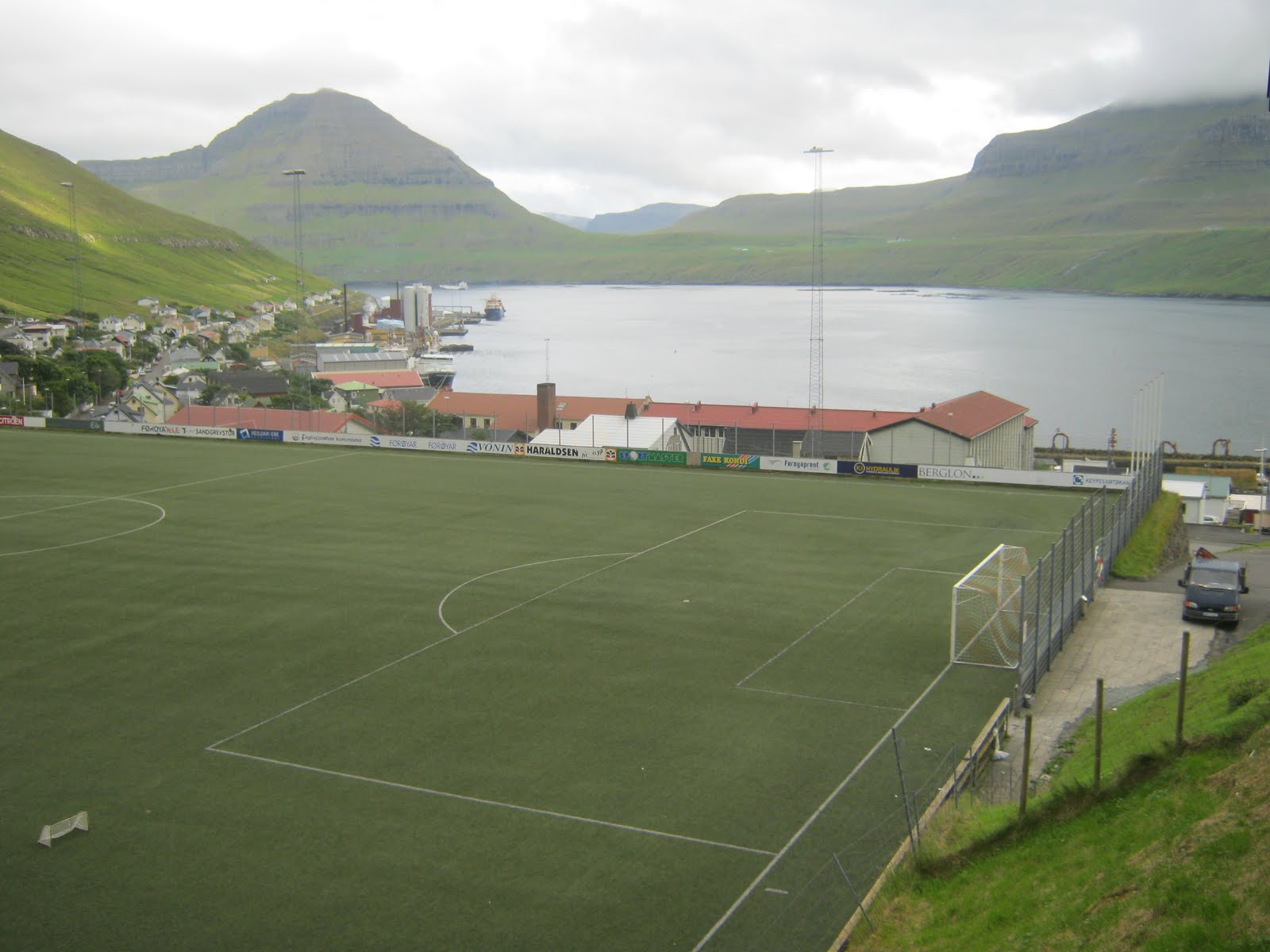
Various Stadia in the Faroe Islands on non-matchdays


Skala IF - Undir Mýruhjalla, Skáli


B71 Sandoy - Inni í Dal, Sandur


KI Klaksvik -Djúpumýra


FC Suðuroy -Vesturi á Eiðinum, Vagur


ÍF Fuglafjørður - Fløtugerði, Fuglafjørður


HB Tórshavn 3 v 1 IF Fuglafjørður


Wednesday 17th August 2011
Meistaradeildin (Faroe Islands Premier League)
Gundadalur Stadium, Torshavn
Admission with programme: 80 DKK
Attendance: 600
Match Rating: 3


For my second and final match during my stay on the Faroe Islands, I made my way to the north of the capital, Tórshavn, to visit arguably the best club football ground on the Faroe Islands, and to watch the reigning champions, HB Tórshavn, who I had watched lose at Vikingur Gøta three days previously in rather bizarre conditions.


The Gundadular stadium is located about a 15 minute walk northwards up the hill from Tórshavn town centre, on a sporting complex and adjacent to the Tórsvøllur stadium, where the Faroe Islands national team plays some of their matches. The stadium has an artificial pitch, as at all club grounds on the Faroe Islands, and has some rather interesting stands. Two clubs share this council owned stadium, fierce rivals HB Tórshavn and B36 Tórshavn, and each team has their own identically shaped all-seater stand in their respective club colours on either side of half way line, and it is in either of these stands where the respective hardcore support gathers. Along the whole opposite length is a rather impressive and uniquely designed, fairly narrow white stand, which has many obstructing narrow pillars and is where visiting and neutral fans tend to congregate. Behind one of the stands is a steep grass bank with a scattering of benches to sit on, and behind the other goal is hard standing. A mountainous landscape makes a pleasant background to the main stand, but is less impressive a backdrop compared to most other spectacular Faorese football ground locations. Programmes were again given out on admission and was a much better offering for the locals than the production produced by Vikingur Gøta with less advertising and more articles and stats to digest.


This evening's match would be between two of the strugglers of the Meistarardeildin this season. As described in my previous report, HB Tórshavn are reigning champions but find themselves second bottom going into this game and in the relegation zone. IF Fuglafjørður were two places better off, in seventh place in the ten team league, but only one point better off than HB Tórshavn. But a sign of how close the lower half of the table was that a win for either side this evening could lift them as high as fifth. This evening's visitors had been in fairly good recent form, claiming seven points from their last four games, following an awful run of gaining just six points from ten games. Two stalwarts of the Faroe Islands national team would be lining up this year, with captain and third most capped player for the Faroe Islands with 66 caps, Fróði Benjaminsen lining up in defence for HB Tórshavn, whilst the second most capped Faroese player of all time with 71 caps, 41 year old Jakup Mikkelsen, lined up in goal for IF Fuglafjørður.


The match started in a lively fashion, and with just six minutes on the clock, the visitors were awarded a penalty following a clumsy tackle from behind, Bogi Løkin scoring with a powerful shot low into the left corner even though the keeper guessed the right way. However, just four minutes later and HB were back on level terms when a ball was pumped forward and wide of goal which Símun Samuelsen calmly slotted past the keeper after driving towards goal. The rest of the first half, and indeed the second half, was competitive with occasional good chances for both teams, but a 1-1 draw looked a certainty as the game entered injury time at the end of the match, when HB were controversially awarded a soft looking penalty. Jón Krosslá Poulsen saw his penalty saved low to the keeper's left, but he was able to react quickly enough to smash home the loose ball. With virtually the last kick of the game, Poulsen, a second half substitute, scored his second and HB's third when a ball forward was not cut out by a defender and an HB forward showed good composure to play the ball across the box to a much better placed Poulsen, who fired home into an unguarded goal. A slightly harsh scoreline on the visitors, but the three points was enough to raise HB into a more comfortable looking sixth place, whilst IF fall to ninth place and second bottom - but with a game in hand and only three points behind fifth placed B68 Toftir.


Vikingur Gøta 3 v 1 HB Tórshavn

Sunday 14th August 2011
Meistaradeildin (Faroe Islands Premier League)
Sarpugerði, Norðragøta
Admission with programme: 80 DKK
Attendance: 400
Match Rating: 3


After a false start the previous day on my trip to the Faroe Islands, when I had planned to watch a second tier game at Skala only to find that the visiting team, the reserve team of 07 Vestur, were unable to field a team, leading to a walkover 3-0 victory for the home team, I set off to Klaksvik on the north-eastern island of Borðoy hoping for more luck at the top flight game, between KI Klaksvik and EB/Streymur. However, during the bus journey to Klaksvik, I noticed a football ground set in such a beautifully dramatic location that, although I continued to Klaksvik to spend some time visiting the town, including a tour around the Djúpumýra stadium, home of KI - another beautifully set location with mountains all around - I decided to abort my plan to stay in Klaksvik to watch my planned game and instead head back to Norðragøta, home of Vikingur Gøta.


The Sarpugerði stadium is located on the north-eastern coast of Eysturoy island, just outside the very small village of Norðragøta, and boasts one of the most dramatic settings for football I have encountered. Behind one corner waves of the Atlantic Ocean come crashing in, whilst behind the rest of the ground are mountains at various proximities. The stadium has one main, modern all-seater grandstand which provides an excellent, elevated and unobstructed view of the action straddling the half way line, whilst on the opposite side is the clubhouse, with covered standing in front. Hard standing is available around the rest of the ground. The ground has a really rugged, wild feel to it, a feeling which was much enhanced by a misty atmosphere and an incredibly strong wind today, which made for a very choppy sea in the background. As with all club football grounds in the Faroe Islands, the pitch is artificial. A pleasant surprise was that programmes are issued at games in the Faroe Islands, included with admission. It has the same size and format as the standard variety found in England, consists of 32 pages, 23 pages of which are solely advertising, but for anyone like me who doesn't understand the Faroese language, team line-ups and league table were sufficient.


Midway through the season and Vikingur are flying high in second place in the league table and look like the only realistic title challengers to current unbeaten leaders B36 Tórshavn, trailing the leaders by two points but nine points clear of EB/Streymur.They are certainly in terrific form winning their last five games, and have won nine of their last ten games, with a defeat at B36 in the middle. Today's visitors, HB Tórshavn, have been the dominant force in Faroese league football in recent seasons, champions in the last two seasons and finishing runners up the season before. This season has seen a rather amazing transformation of fortunes though, as they currently occupy a relegation place, in ninth place in the ten team league. They have been on an awful run in recent months, picking up just eight points from their last 11 games, although they came close to a spectacular result in the Champions League, when they were leading Malmo 1-0 on the night in the second leg in Tórshavn, losing just 1-2 overall, before a late equaliser finally ensured progress for the Swedes. Earlier in the season, Vikingur triumphed 2-1 in Tórshavn.


In some of the windiest conditions I have ever experienced at a football game - making difficult for even spectators to walk around the ground, let alone play a game of football in, the game was something of a lottery. The ball couldn't be placed for set-pieces, meaning that goal kicks had to be taken hurriedly with the ball rolling in the wind, and free kicks had to be held until the last second by a colleague. It was impossible to play any kind of measured football, although credit to both teams for having the intelligence to mostly play the ball along the ground, and to use the wind for long distance speculative drives. HB had the very strong wind behind them in the first half, so it was little surprise that they dominated proceedings, nor when they took the lead on 23 minutes, when Rogvi Holm poked in at the far post when the ball was played across the box following a corner. Two minutes before half time and the home side were back on level terms though when good composure was shown in playing the ball across the box for Sam Jacobsen to fire home from 12 yards. Scoring against the wind was to prove crucial for the home side.


In the second half, it was Vikingur's turn to have the advantage of the wind behind them and so had the upper hand. They took the lead on 63 minutes when Erling Jacobsen stabbed home from close range after a powerful header was saved. The rest of the match was played almost exclusively in HB's half, but the one goal lead always looked a little shaky, and the game was not put to bed until virtually the last kick of the game, when a free kick was looped into the box and Finnur Justinsson scored with a firm header from the edge of the box.


Sunday, 7 August 2011

England 23 v 19 Wales

Saturday 6th August 2011
Rugby Union International
Twickenham, London
Admission: £30.00
Programme: £5.00
Attendance: 80,945
Match Rating: 3


Today was the opening day of many leagues in the football season, however it was to the home of rugby I went to today. I have always wanted to watch England play at Twickenham in a major international match, but tickets are generally almost impossible to come by (certainly without making use of the touts). However, for this very early season Test match, acting as one of three warm-up matches before the Rugby Union World Cup in New Zealand next month, I was able to purchasr tickets several months ago. It was in many ways an ideal match for me personally to take in, being against Wales, the country where I lived for five years, and where I had all watched all of my previous rugby matches, country and club.


Twickenham is located about a twenty minute walk from the train station, and arriving at the station only three quarters of an hour ahead of kick off, progress was slow in the middle of a thick of crowd of people also making their way to the game. After a very quick tour around the outside of the ground, I made my way through the turnstiles and then made the long climb up to the top of the stadium for my seat in the north-west corner of the upper tier of the ground. The stadium is certainly an impressive facility, which is perhaps more appreciated from such an elevated view as I had. It has a continuous design of three tiers of seating, with more than enough legroom, and it has a very intimate feel to the place which makes for a fantastic atmosphere acoutiscally. The South Stand is the newest part of the ground, having been reconstructed in 2006, but as mentioned, there is little sign that is was built separately from the rest of the stand, as it blends in seamlessly with the other stands, except that the roof is clearer than around the rest of the stadium. The 76 page programme was exactly what one would expect from an international publication - very professional, plenty of relevant information to read about both teams and other interesting articles such as the history of the World Cup, but overpriced at £5.00.


Today's match would be a rusty affair more about finding fitness and form, being the first competitive game of the season for the players, well before the league season starts. England won the Six Nations earlier this year, having won their first four games, including a 26-19 victory in Cardiff against Wales, before being denied the Grand Slam by losing their final game to Ireland in Dublin. Wales finished in fourth place, winning three and losing their other two games.


As the teams burst on to the pitch through fire cannons, it was rather disappointing to see England in their new black change kit for this game, and after considerable build-up, fanfare and rousing national anthems - even as a proud Englishman, the Welsh national anthem will always make the hairs on the back of my neck stand on end, the game began in front of a packed house. With six minutes on the clock, England opened the scoring with a long range penalty from near the half way line by Johnny Wilkinson. Wales soon hit back though, and following length possession and pressure close to the try line, George North scored a try in the corner, which was well converted by Rhys Priestland from close to the touchline. England responded well though and soon scored a try of their own through James Haskell following a scrum, Wilkinson converting, to give England a 10-7 lead. They continued to dominate proceedings, and two minutes before half time, Wilkinson extended England's lead with a simple drop goal, to make the score 13-7 at half time.


England continued their dominance into the second half and soon extended their lead when debutant Manu Tuilagi evaded a couple of tacklers before scoring a try underneath the posts, easily converted from close range by Wilkinson for a commanding 20-7 lead. Soon after came a rather sad moment with the Welsh player Morgan Stoddart having to be carried off with a suspected broken leg, to put paid to his chances of playing in the World Cup. However, this seemed to spur Wales on, as Shane Williams showed some good trickery to score in the corner, but this time Priestland missed the conversion. Another drop goal from Wilkinson - a real class act with his faultless kicking and orchestrating proceedings - extended England's lead to eleven points. Shortly afterwards, it was England who suffered an injury, captain Lewis Moody limping off with a tweak to his knee. Wales continued to be more than a match for their hosts, and Sam Warburton was denied a try by the TV referee. He soon played a major role in Wales scoring a try though, breaking forward and eventually North converted in the corner. This time, Priestland made no mistake with the conversion. England saw the game out in the remaining minutes to hold on for a four point win. This game was hardly a classic, inevitably for a game played so early in the season, but both sides will take positives from the game, and the two teams will play each other again next Saturday in Cardiff. Once again, the route back to the train station was heavily congested - it's well worth not planning on being in a hurry after a game at a packed Twickenham!